
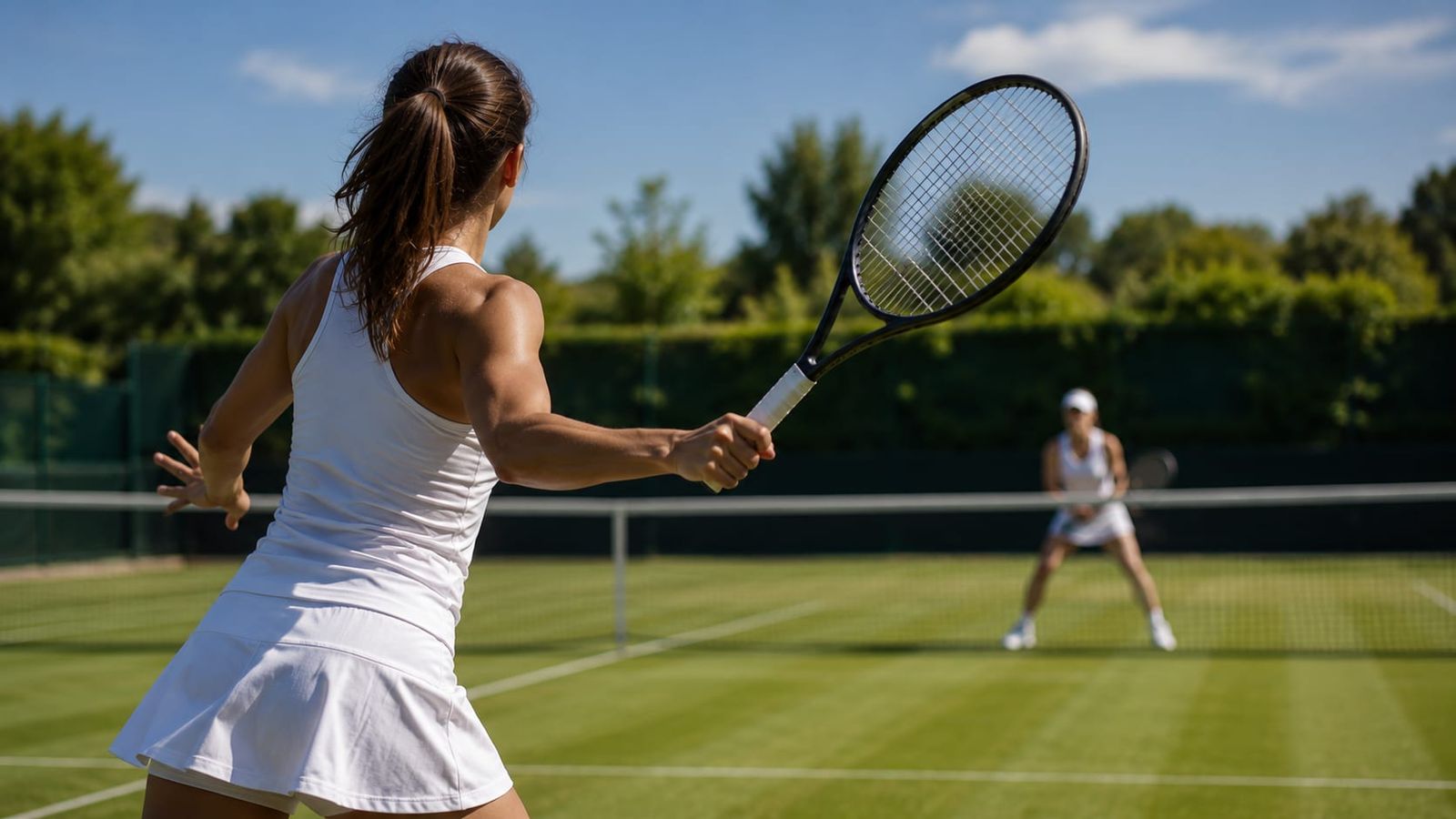

You play tennis regularly. Your technique is decent, your court time is consistent, but something is holding you back. You tire in the third set. Your serve lacks pop. You keep picking up the same niggling shoulder or knee issue. The problem usually is not your game; it is the physical foundation underneath it.
I work with a lot of City professionals who play tennis seriously but train generically. They do some gym work, maybe a bit of cardio, but nothing that is actually built around what tennis demands. That gap between general fitness and sport-specific preparation is where most of the gains are sitting.
What Tennis Actually Demands Physically
Tennis is a sport of repeated short, explosive efforts with very little predictability. You are changing direction constantly, loading one side of your body heavily, generating power through rotation, and doing all of this for anywhere from forty minutes to two-plus hours depending on the match.
The physical demands break down into a few clear areas: rotational power for groundstrokes and serve, lateral speed and deceleration for court coverage, shoulder stability and strength for overhead work, and the aerobic base to sustain quality across a full match. Most recreational players have some of these, but rarely all of them in proportion.
The asymmetry issue is worth flagging specifically. Tennis loads the dominant side hard. Over time, without structured work to address it, that creates imbalances in shoulder strength, hip mobility and spinal rotation that both limit performance and increase injury risk. This is not a minor concern; it is one of the first things I look at when a tennis player comes in.
Why Generic Gym Training Does Not Transfer Well
There is nothing wrong with general fitness work. But if your gym sessions are not designed around what tennis requires, you are essentially building a car and hoping it happens to be the right one for the road.
A lot of tennis players I see have done plenty of pressing work but not enough pulling. They have trained in straight lines but not in the rotational patterns the sport actually uses. They have worked on strength but not on the speed of force production, which is what actually matters when you are trying to generate racket head speed or push off hard to reach a wide ball.
The other issue is that generic training often ignores the positions tennis puts you in. A heavy barbell squat is a useful exercise, but it does not prepare your body for the split-step landing, the low wide stance on a defensive slice, or the hip hinge and rotation of a kick serve. The exercises need to connect to the movement patterns of the sport.
How I Structure a Tennis Performance Programme
When a tennis player comes to me, the first thing we do is build a clear picture of where they are physically. That means looking at strength, mobility, any injury history, and how their body actually moves. From there, the programme is built around what they specifically need, not a generic tennis template.
Rotational Power and Serve Speed
Most of the power in a tennis stroke comes from the ground up, through the legs and hips, into the trunk, and out through the arm. If any link in that chain is weak or restricted, you lose power and often compensate in ways that stress the shoulder or elbow.
I use loaded rotational work, hip hinge patterns and anti-rotation exercises to build that chain. The goal is not just strength in isolation; it is the ability to produce force quickly and transfer it efficiently. For a lot of players, improving hip mobility and trunk rotation alone makes a noticeable difference to serve speed and groundstroke depth.
Lateral Speed and Change of Direction
Tennis is not a sport you play in straight lines. The ability to push off hard, change direction quickly and decelerate under control is fundamental to court coverage, and it is trainable.
This is an area where sport science knowledge genuinely pays dividends. Understanding how force is produced and absorbed in lateral movement means the training can be specific and progressive, rather than just doing agility ladder drills and hoping for the best. We work on single-leg strength, hip stability and the mechanics of deceleration, because that is where a lot of knee and ankle problems originate.
Shoulder Resilience and Injury Prevention
The shoulder takes a lot of load in tennis, particularly in serving and overhead play. Rotator cuff strength, scapular control and the balance between the muscles that internally and externally rotate the shoulder are all important. When these are out of balance, you get the kind of shoulder pain that keeps coming back.
Because I work inside a healthcare clinic at Elevate LDN, if something surfaces during training that needs clinical input, a physiotherapist or chiropractor is available in the same building. That matters when you are dealing with a shoulder that has a history. The training and the clinical support can work alongside each other rather than in separate silos. You can read more about how that works on the Personal Training Inside a Healthcare Clinic page.
Aerobic Conditioning and Match Endurance
Tennis matches at recreational level can last a long time, and the ability to maintain quality in the later stages of a match is partly a fitness question. I include conditioning work that reflects the actual energy demands of tennis: short, intense efforts with incomplete recovery, rather than steady-state cardio that does not replicate what happens on court.
This does not mean endless interval sessions. It means building a solid aerobic base first, then layering in work that trains the body to recover quickly between points and games.
Fitting This Around a Busy Schedule
Most of the people I work with at Elevate LDN are City professionals. Training time is limited, and it has to count. Two sessions a week is usually enough to make real progress, provided the sessions are structured and the programming is progressive.
The studio is a three-minute walk from Bank and Monument stations, which makes it practical for early morning sessions before work or a lunchtime slot. There are showers and changing facilities, so you can train and head straight back to the office. No membership, no contracts; you book sessions when they work for you.
The written programming I provide between sessions also matters. Knowing what you are doing, why you are doing it and how it connects to your tennis gives you something to work with independently, and it means the in-person sessions can focus on the things that actually need coaching rather than just supervision.
When Injury History Is Part of the Picture
A lot of tennis players come in with something that has been grumbling for a while. A shoulder that flares up after heavy serving. A knee that does not like lateral movement. Lower back tightness that builds through a match. These are common, and they are usually manageable with the right approach.
The key is that the training has to account for the injury, not ignore it. That means understanding what is actually going on, adjusting loading and exercise selection accordingly, and building the strength and stability that reduces the likelihood of it recurring. If the injury needs clinical assessment first, the on-site team at the clinic can do that, and we can align the training with whatever they recommend.
This is one of the genuine advantages of training in a clinical setting. It is not just a gym with a physio nearby; it is a setup where the training and the clinical care are designed to work together. You can find out more about the full team on the Meet Our Specialist Personal Trainers page.
What Progress Actually Looks Like
Progress in sports performance training is not always immediately visible in the gym. The place you notice it is on the court. You get to a ball you would have missed. Your serve holds up in the third set. The shoulder that used to ache after a match feels fine.
That is the point of the work. Not numbers on a screen or a personal best on a lift, but a measurable improvement in what you can actually do in your sport. I have a background in semi-professional rugby, so I understand what it means to train for a sport rather than just for general fitness. The specificity of the preparation is what makes the difference.
One client I have worked with on golf fitness put it well: after consistent work on mobility and strength, he added fifteen yards off the tee. The principle is the same for tennis. When the physical limitations are addressed specifically, the performance follows.
Getting Started
If you play tennis regularly and want to understand what is actually limiting your game physically, the starting point is a consultation. We look at where you are, what you need and what a realistic programme looks like given your schedule and goals.
You can find out more about Sports Performance Personal Training in the City of London or take a look at my trainer profile if you want to know more about my background and approach. If you are ready to book, the Find Us page has everything you need to get in touch.