
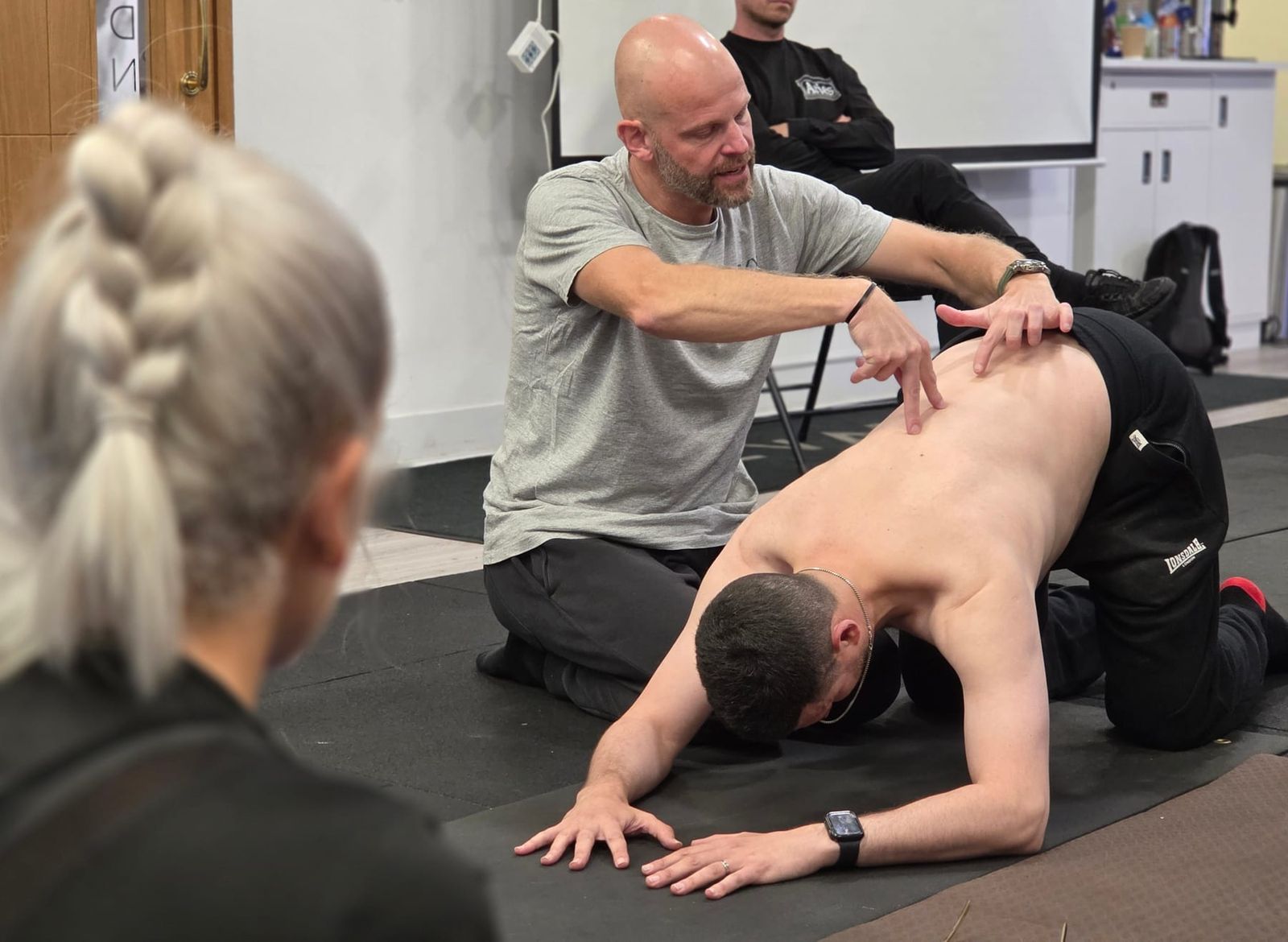

DNS stands for Dynamic Neuromuscular Stabilisation. If you have come across the term through a physiotherapist, through the growing conversation around longevity and healthspan, or simply by searching for a better approach to movement and rehab, you are in the right place.
I use DNS with virtually every client I work with. It underpins how I assess movement, design programmes, and make decisions about what someone actually needs. Here is what it is, how it works, and why it matters.
Where does DNS come from?
DNS was developed by Professor Pavel Kolar at the Prague School of Rehabilitation. It builds on the work of some of the most influential figures in rehabilitation science: the Czech neurologists Karel Lewit and Vladimir Janda, and developmental neurologist Professor Vaclav Vojta.
The system has been in development since the 1990s and is now used by clinicians, physiotherapists, and movement professionals across the world. It is not a trend or a marketing exercise. It is a framework built on decades of clinical research and neurological science.
The core principle: developmental kinesiology
DNS is built on the study of how human movement develops from infancy. This is called developmental kinesiology.
Every healthy infant follows a predictable, genetically hardwired sequence of motor development. They learn to stabilise their head, roll, crawl, kneel, and eventually stand and walk. Nobody teaches a baby to crawl. The nervous system does it automatically, following the same sequence in every healthy child.
The key insight is that these early movement patterns represent optimal motor function. When adults develop pain, stiffness, or movement dysfunction, it is often because they have lost or compensated for these foundational patterns over years of sitting, injury, or poor training habits.
DNS gives us a systematic way to assess which patterns have been disrupted and a framework for restoring them. That is what makes it so valuable: it does not target individual muscles in isolation, it restores how the whole stabilising system is supposed to work.
How is DNS used in practice?
Rehabilitation
For people recovering from back surgery, managing chronic pain, or dealing with conditions like disc herniation, DNS provides a structured approach to rebuilding core stability and functional movement from the ground up. Rather than isolating a single muscle and hammering it with exercises, DNS addresses the coordinated function of the entire stabilising system. The difference between the two approaches, in terms of long-term outcomes, is significant.
Sports performance
Athletes use DNS to identify and correct movement inefficiencies that limit performance or increase injury risk. When I work with my golfers, for example, the DNS assessment often reveals that a limitation in their swing is not a golf-specific problem at all. It is a stability or mobility deficit that has been there since long before they picked up a club. Address the foundational issue and the performance follows.
General fitness and longevity
DNS has gained significant traction in the longevity space in recent years, and for good reason. If you want to be moving well at 70 or 80, the quality of your movement patterns now is probably the most important variable. More important than how much you can lift or how fast you can run.
DNS gives you a way to assess and improve those patterns, rather than just pushing harder and hoping for the best.
For anyone who trains regularly, it also provides a framework for understanding why certain exercises feel wrong, why certain positions are difficult, and what is actually limiting your progress.
What does a DNS assessment involve?
A DNS assessment starts with breathing. That might sound unusual, but breathing mechanics, specifically how the diaphragm functions and how intra-abdominal pressure is regulated, are foundational to the entire approach. If the breathing is off, everything built on top of it will be compromised.
From there, a trained assessor evaluates your movement quality through a series of developmental positions: lying on your back, lying face down, on all fours, kneeling, and standing. These mirror the positions a developing infant moves through, and they reveal where your stabilisation system is working well and where it is not.
The goal is to identify where joints are not properly centrated, where compensatory patterns have developed, and where the nervous system has found workarounds that might be creating pain or limiting performance. It is a thorough process, and it gives me far more useful information than a conventional fitness assessment or movement screen.
Who benefits from DNS?
DNS is relevant for a wide range of people, which is one of the reasons I use it so broadly:
- Post-surgical patients returning to movement after spinal or joint surgery
- Chronic pain sufferers who have not responded well to conventional treatment
- Athletes looking to improve performance and reduce injury risk
- Desk workers dealing with the consequences of years of prolonged sitting
- Older adults focused on maintaining movement quality, independence, and longevity
If there is a common thread, it is that DNS works best for people who want to understand why they move the way they do, not just be told what exercises to perform.
What are your next steps with DNS?
If you have read this far, you are probably in one of two camps. Either you want to experience DNS-based training for yourself, or you are a health and fitness professional interested in getting certified. Both are worth doing, and I have outlined what each path looks like below.
I want to train with a DNS-certified trainer
If you are dealing with chronic pain, recovering from surgery, or simply want your training to be built on a proper understanding of how you move, DNS-based personal training is a good place to start. The assessment process I described above is how every client relationship at Elevate LDN begins, and it changes the way your programme is designed from day one.
You can find out more about how we use DNS in our rehabilitation and corrective exercise training, or get in touch to book an initial assessment.
I want to become DNS certified
DNS offers several certification tracks. The Exercise and Sport track is the most relevant for personal trainers and strength coaches and the most accessible for manual therapists. It consists of three courses:
- Part I: Core principles, breathing mechanics, and foundational developmental positions
- Part II: Higher positions, resistance integration, and sport-specific applications
- Part III: Advanced clinical applications, case studies, and the practical certification exam
Completing all three and passing the practical exam earns the title Certified DNS Exercise Trainer (DNSET), awarded by the Prague School of Rehabilitation.
We host all three DNS Exercise courses at our studio in the City of London. If you are a health or fitness professional looking to take your assessment and programming to a different level, it is the most rigorous certification I have come across.
Why does DNS matter?
Most training approaches start with what someone wants to achieve and then try to load them up to get there as quickly as possible. DNS starts with how someone moves, identifies where the system is not working properly, and builds from there.
That is the difference between stacking load on top of dysfunction and building a foundation that actually supports long-term progress. Take the time to get the foundation right and the results come faster, not slower.
For my clients, working with a DNS-trained practitioner means their movement is being assessed and addressed at a level most conventional training never reaches. For practitioners, DNS improves your clinical reasoning and gives you a framework that makes you more effective with every client you see.
That is what drew me to it, and it is what keeps it at the centre of everything I do.